As Nigeria experiences rapid urbanisation, growing climate-related pressures and increasing demands on public infrastructure and essential services, the Joint National Association of Persons with Disabilities (JONAPWD) is strengthening its strategic commitment to ensuring that the country’s cities are accessible, inclusive, resilient and sustainable for everyone, particularly persons with disabilities who continue to experience systemic barriers to urban participation and development.
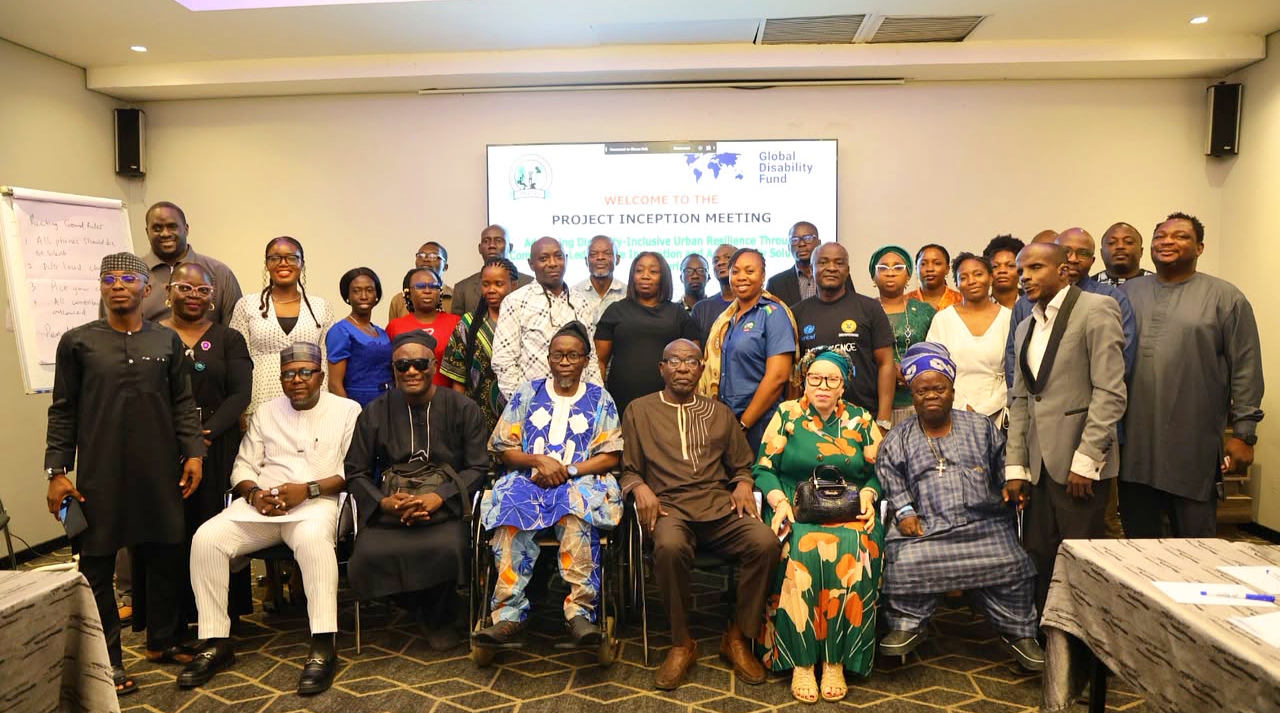
This commitment gained renewed momentum on Tuesday, 27 October 2026, at the Radisson Hotel, Ikeja, Lagos, during the inception meeting of the project, “Advancing Disability-Inclusive Urban Resilience through Community-Led Innovations and Accessibility Solutions.” The initiative is supported by the United Nations Global Disability Fund (GDF), a UN inter-agency, multi-partner funding mechanism formerly known as the United Nations Partnership on the Rights of Persons with Disabilities (UNPRPD), through its Resilient and Inclusive Cities Hub (RICH).
For JONAPWD, the initiative represents an important step towards translating its national strategic vision for disability-inclusive development into practical institutional reforms that can influence how Nigerian cities are planned, governed and sustained. While Lagos State serves as the initial demonstration location, the broader ambition is to establish a replicable model through which accessibility, disability-inclusive data, digital innovation and meaningful participation become integral components of urban governance across Nigeria.
Nigeria’s urban transformation presents enormous opportunities for economic growth, technological advancement, improved mobility, public service delivery and social participation. However, these opportunities cannot be considered equitable when persons with disabilities remain disproportionately affected by inaccessible transport systems, public facilities, information platforms and urban environments. Such barriers are further compounded by flooding, extreme rainfall, heat stress and other environmental pressures, which can intensify existing inequalities and restrict access to essential services.
Beyond physical accessibility, a fundamental challenge lies in the limited generation, availability and systematic application of disability-disaggregated data within urban planning and government decision-making. Where the experiences and priorities of persons with disabilities are inadequately documented, public institutions may lack the evidence necessary to identify accessibility gaps, prioritise interventions and monitor whether development outcomes are genuinely inclusive.
JONAPWD therefore considers disability-inclusive urbanisation not simply an infrastructure concern, but a critical question of governance, institutional accountability, equitable participation and sustainable development. Building resilient cities requires more than responding to environmental pressures; it requires strengthening the systems through which governments understand diverse community needs and translate evidence into inclusive planning decisions.
This vision aligns strongly with the United Nations Convention on the Rights of Persons with Disabilities (UNCRPD). Article 9 establishes accessibility as an essential condition for independent living and full participation, requiring equal access to the physical environment, transportation, information and communication technologies, and public facilities and services. Article 4(3) reinforces the obligation to closely consult and actively involve persons with disabilities through their representative organisations in decisions affecting them. Article 21 further recognises accessible information and communication, while Article 31 establishes the importance of appropriate statistical and research data for developing and implementing disability-inclusive policies.
Together, these provisions affirm that accessibility, meaningful participation and reliable disability data are not optional development considerations, but fundamental elements of rights-based governance. They also reinforce JONAPWD’s commitment to advancing Nigeria’s implementation of the UNCRPD through practical partnerships, institutional strengthening and evidence-informed advocacy.
The initiative equally contributes to the United Nations 2030 Agenda for Sustainable Development, particularly Sustainable Development Goal 11, which calls for inclusive, safe, resilient and sustainable cities and human settlements. It also supports SDG 10 on reducing inequalities; SDG 9 on inclusive infrastructure and innovation; SDG 13 on climate resilience; SDG 16 on accountable and inclusive institutions; and SDG 17 on partnerships for sustainable development. These commitments collectively reinforce the global principle of leaving no one behind and recognise that sustainable development cannot be achieved where persons with disabilities remain excluded from the systems and opportunities shaping their communities.
The Lagos inception meeting provided an opportunity for government institutions, Organisations of Persons with Disabilities (OPDs), technical actors and other stakeholders to establish a common understanding of the project’s objectives, governance arrangements and implementation priorities. Discussions reinforced the importance of integrating disability inclusion into existing urban resilience and development processes rather than creating parallel systems with limited prospects for long-term institutional ownership.
The project presentation initially identified Eti-Osa and Lagos Island Local Government Areas as pilot locations. Stakeholders subsequently proposed Lagos Island and Agege LGAs as an alternative configuration to reflect the different urban realities of island and mainland communities. This recommendation will be considered within the project’s implementation planning and site-selection arrangements.
Central to the initiative is the recognition that persons with disabilities possess essential knowledge about the accessibility barriers that shape everyday urban experiences. Through participatory accessibility assessments, community walk-throughs, Geographic Information System (GIS) mapping and disability-inclusive data collection, the project will support the systematic identification and documentation of barriers affecting access to public spaces, mobility routes, facilities and essential services.
The evidence generated will be jointly reviewed and validated by OPDs, technical practitioners and relevant government institutions. Accessible digital dashboards and community feedback mechanisms will support the interpretation of findings, identification of priority accessibility concerns and monitoring of institutional responses. Through this approach, the project seeks to strengthen the routine use of disability-inclusive evidence within local government decision-making and implementation of the Lagos State Resilience Plan.
Importantly, the initiative is not intended merely to produce maps, digital platforms or technical reports. Its greater significance lies in demonstrating how credible community-generated evidence can influence institutional practices, improve the quality of public decisions and strengthen accountability to persons with disabilities.
This reflects JONAPWD’s wider strategic ambition to advance disability inclusion from periodic consultation and project-based interventions towards sustained participation in public governance. As Nigeria’s national umbrella organisation of persons with disabilities, JONAPWD will leverage its networks, technical experience and institutional relationships to promote the meaningful involvement of diverse disability constituencies, including women and young persons with disabilities and those from historically underrepresented groups.
Their participation will extend across project governance, accessibility assessments, data validation, interpretation of findings, identification of priorities and monitoring of outcomes. Such an approach gives practical expression to the disability movement’s principle of “Nothing About Us Without Us”, while recognising persons with disabilities as rights-holders, knowledge contributors and partners in shaping sustainable urban development.
The project also reflects the broader direction of the United Nations Disability Inclusion Strategy, which promotes disability inclusion across institutional leadership, strategic planning, programming and accountability. For JONAPWD, these principles underscore the importance of ensuring that inclusion is embedded within mainstream government systems rather than treated as a separate or secondary development priority.
Looking beyond Lagos, JONAPWD envisages that the lessons, tools and institutional practices emerging from the pilot will provide a foundation for engaging other Nigerian states, local authorities, urban development institutions and development partners. As cities expand and digital technologies increasingly influence public administration, accessibility and disability-inclusive data must become standard considerations in urban planning, public service delivery and development monitoring.
This national ambition also aligns with the Global Disability Fund’s wider RICH vision of supporting cities that are accessible, equitable and sustainable, while promoting collaboration among governments, OPDs, United Nations entities and technical partners. The Lagos experience offers Nigeria an opportunity to contribute practical knowledge to this emerging global agenda and demonstrate how locally generated evidence can support institutional change.
Ultimately, the success of the initiative will be measured not solely by the accessibility information collected or digital systems established, but by the extent to which the evidence informs government priorities, strengthens meaningful participation and contributes to more accountable and inclusive urban governance.
For JONAPWD, a resilient city is not simply one that withstands environmental and development pressures, but one whose institutions, services, information systems and opportunities remain accessible and responsive to the diversity of its population.
As Nigeria continues to shape its urban future, the message is clear: persons with disabilities must not remain invisible in development data, absent from planning decisions or excluded from the benefits of urban growth. Through this Lagos pilot and its broader national strategic vision, JONAPWD is advancing a future in which disability inclusion becomes a defining measure of sustainable urbanisation, institutional effectiveness and equitable development across Nigeria.
The future of Nigeria’s cities must be accessible by design, inclusive in governance, resilient in practice and sustainable for all.