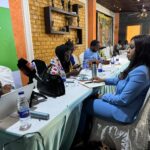
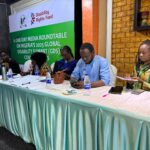
As Nigeria navigates its developmental milestones, the gap between policy formulation and practical execution remains a significant hurdle. This disparity was the focal point of the recent intensive Media Roundtable on the Global Disability Summit (GDS) Commitments. The gathering brought together key leaders from the disability community and media professionals to dissect the country’s progress and stagnation on disability legal instruments and human rights frameworks.
The message of the roundtable was clear: Nigeria possesses robust frameworks on paper, but without strategic media amplification, these commitments risk becoming obsolete before they are ever realized.
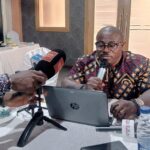
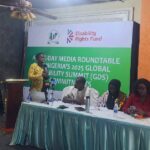
1. The Power of the Press: Unlocking Restrictive Spaces
A recurring theme throughout the roundtable was the media’s unique institutional access. While advocacy groups face physical and bureaucratic barriers, journalists carry an invisible pass into the chambers of power.
“We started this meeting late this morning because we were informed that there is something going on in the National Assembly. And we do not have the keys to the National Assembly. All of you have that key. So we need you to use those keys to unlock spaces where we cannot get to and help us to demand that if it is about climate action, what is the state for persons with disability?” – JONAPWD
Disability issues are inherently cross-cutting, intersecting with employment, infrastructure, climate change, and healthcare. JONAPWD urged the media to actively integrate these perspectives into everyday reportage, especially during high-profile interviews with political leaders. When the media continuously questions authorities on inclusion, it forces disability rights into mainstream policy execution.
2. Dignity in Diction: Moving Beyond Abbreviations
One of the most passionate debates centered on media ethics, language, and style guides. Representatives of the disability community firmly challenged the journalism industry’s default practice of using abbreviations like “PWDs” or phrases like “living with disabilities” to save character count or airtime.
“Please, you refer to persons with disabilities in full. We don’t use abbreviations, not even in writing. That’s very critical for us… We do not abbreviate the humanity of anyone. So, if I’m not going to do it to someone without a disability, I shouldn’t do that with someone with disabilities.” – JONAPWD
The roundtable advocated for progressive learning within newsrooms. While media professionals cited technical constraints on lower-third graphics or strict radio run-times, the consensus leaned toward intentional public sensitization. Shorthand terms like “PWDs” often obscure the message to the general public, whereas explicit phrasing consistently reinforces human dignity and constitutional identity.
3. Deconstructing Homogeneity: The Critical Need for Consultation
A major flaw in current public and private empowerment interventions is the mistaken assumption that all persons with disabilities share identical needs. Leaders emphasized that the community consists of distinct clusters, including physical, visual, auditory, and intellectual impairments, each requiring tailored solutions.
“Hearing aids are important to those that have residual hearing. It is not all deaf persons that have residual hearing. I am totally deaf… If you give me hearing aids, you are giving me a headache… I would rather prefer you give me technological assistive devices such as smartphones or empowerment machines… It is from the place of knowledge where you understand that this group has different needs. They have different priorities.”
Whether addressing individuals affected by polio versus spinal cord injuries, or navigating diverse communication access, the ultimate solution lies in proactive co-design. Tokenistic, top-down charity initiatives must give way to formal consultative frameworks.
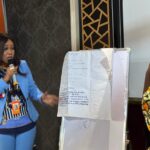
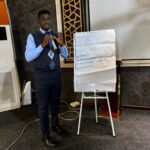
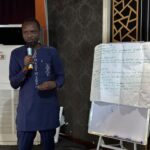
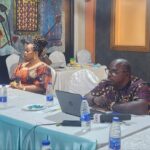
4. Tracking the GDS Gaps: Education, Health, and Infrastructure
During interactive working group sessions, journalists examined specific timelines within the national GDS action plan. The findings revealed a jarring gap between official timelines and real-world implementation:
- Inclusive Education: Government pledged to transition 70% of out-of-school children with disabilities back into classrooms by December 2028. However, the reality remains heavily stymied by poor data tracking, insufficient funding, inaccessible classrooms, and a shortage of trained special-needs educators.
- Accessible Information & Broadcasting: While commitments exist for full broadcasting accessibility via the National Broadcasting Commission (NBC) by 2027, digital information channels remain largely unoptimized. Websites and public platforms continue to be launched without accessibility evaluations or representative testing.
- Healthcare Equity: Physical infrastructure in medical centers remains a major barrier. Even where public ramps are constructed as an afterthought, internal configurations like narrow nursing stations and inflexible examination beds violate patient privacy and dignity.
5. The Path Forward: Solution Journalism and Legal Sanctions
To move past a cycle of merely documenting grievances, the roundtable highlighted Solution Journalism as an indispensable framework. By shifting focus toward investigative, evidence-backed reporting that highlights actionable interventions, media narratives can directly catalyze institutional support and policy adjustments.
“Solution journalism focuses on a particular problem, providing solutions to a particular problem a community or a certain group of people face. If we have an issue of disability inclusion for instance, we drive conversation around inclusion… and that solution can be provided. It’s a new concept in journalism that is seriously being deployed right now.”
Concurrently, the media must champion stories that demand strict enforcement of the Discrimination Against Persons with Disabilities (Prohibition) Act.
“The story will look at that extensively and then bring out the plight, their voices on the challenges they face. And then, most importantly, we also try to craft a story… of a graduate with disability who missed several job interviews due to inaccessible infrastructure… If the government can enforce tax law and enforce other laws, why not enforce this law that has to do with persons with disability?”
True societal inclusion cannot occur in a vacuum. It requires a unified front where the Joint National Association of Persons with Disabilities (JONAPWD), the apex federation representing all clusters across Nigeria’s 36 states and 774 local governments, works hand-in-hand with an informed, uncompromising press corps. By treating disability issues not as occasional charity features, but as fundamental matters of legal accountability, national development, and human rights, the media can ensure that the GDS commitments actively transform lives.