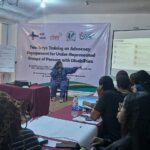
Day 2 of the training on Advocacy Engagement for Mentees and Persons with Lived Experiences, unfolded as more than just a continuation of learning—it became a defining moment of transformation. It was a masterclass not in theory, but in practice. Because while advocacy plans may look impressive on paper, real impact lies in mastering the subtle, often overlooked “tiny skills” and grounded terminology that drive collective understanding and action.
This session pushed participants beyond the comfort zone of “knowing” into the demanding, yet rewarding space of “doing.” It emphasized a critical truth: expertise is not static. In a rapidly evolving landscape, especially within disability advocacy, yesterday’s knowledge can quickly become today’s limitation.



The Power of Language in Advocacy
One of the most striking lessons from the day was the central role of language. Words are not just tools for communication—they are gatekeepers of progress. Using outdated or inappropriate terminology doesn’t just weaken your message; it can completely undermine it.
As Madam Ekaete Umoh, the Chairperson of FACICP, and faciliator of the session on ‘Language, Awareness, Representation, and Collaboration’, stated:
“That thing that you think you know—it’s time to apply. If you’re not well-grounded, no matter the ChatGPT or AI, you will mess it up.”
This statement reflects a growing reality: access to information is no longer enough. Without deep understanding and contextual awareness, even the most advanced tools cannot compensate for weak foundations.
From Individual Blame to Societal Responsibility
A key highlight was the exploration of the evolution of disability models, particularly the shift toward the social model. This framework challenges traditional thinking by redirecting responsibility away from individuals and toward societal structures.
As expressed during the session:
“Social model came with another concept, challenging those theories and… pushing the arrows back to society.”
This shift reframes disability not as a personal limitation, but as a consequence of inaccessible systems, environments, and attitudes. It is a powerful lens for advocacy—one that demands systemic change rather than individual adjustment.
Inclusive Facilitation: Beyond the One-Size-Fits-All Approach
Another critical takeaway was the importance of intentional inclusion in facilitation. True participation goes far beyond simply inviting people into the room—it requires creating environments where everyone can meaningfully engage.
This includes:
- Using visual aids to enhance understanding
- Incorporating sensory breaks
- Designing sessions that accommodate people with intellectual disabilities
Inclusion is not accidental; it is designed.
Rethinking Media Narratives
The session also challenged the way disability is portrayed in the media. Too often, narratives are framed around pity or inspiration, reducing individuals to “victim stories” or “human-interest features.”
The call to action was clear: shift toward authentic storytelling that highlights access, agency, and development. Representation should empower, not diminish.
From Beneficiaries to Strategic Partners
One of the most compelling insights centered on the role of Disabled People’s Organizations (DPOs). The distinction between being seen as a beneficiary versus a partner is not just semantic—it is strategic.
When DPOs are positioned as beneficiaries, they are sidelined. But when they are recognized as experts, they gain influence and a seat at the decision-making table.
This aligns with the enduring principle:
“Nothing about us without us.”
More than a slogan, this is a non-negotiable standard for meaningful inclusion and authentic participation.
The Urgency of Continuous Learning
Perhaps the most humbling takeaway of the day was the reminder that learning never stops. In a field where language, frameworks, and best practices are constantly evolving, staying relevant requires ongoing effort.
As one powerful quote emphasized:
“You can’t be too smart in the disability space and not continue to improve your rate. Terminology is evolving; what you taught me yesterday is obsolete today.”
Final Reflections
Day 2 of the RIA training was a call to action—a reminder that effective advocacy is not just about passion or knowledge, but precision, adaptability, and intentionality.
It challenged participants to rethink their assumptions, refine their language, and recommit to practices that center dignity, inclusion, and partnership.
Because in the end, reframing the narrative is not just about changing words—it’s about changing systems, perceptions, and outcomes.