In every humanitarian emergency, shelter is more than a roof. It is the foundation of safety, dignity, privacy, protection and recovery. Yet for many persons with disabilities, displacement sites and humanitarian shelters can reproduce the barriers that existed before an emergency and sometimes create new ones. An inaccessible pathway can separate a person from food assistance. An inaccessible toilet can undermine health and dignity. An early-warning message delivered in only one format can become a matter of life and death.
It is within this reality that the Joint National Association of Persons with Disabilities (JONAPWD) is providing strategic leadership under the programme, “Strengthening Accessibility and Livability of IDP Camps for Persons with Disabilities in Nigeria.” JONAPWD’s role extends beyond implementing isolated disability activities or mobilising beneficiaries. As Nigeria’s national umbrella Organisation of Persons with Disabilities, the Association is positioned to lead disability mainstreaming throughout shelter, settlement, camp coordination and camp management systems.
The programme reflects the central vision of the Global Shelter Cluster’s All Under One Roof guidance: humanitarian organisations must move beyond good intentions and translate disability inclusion into practical action. The guidance calls for stronger disability networks, accessible evacuation centres, inclusive early-warning systems, systematic identification of barriers, consultation with persons with disabilities and the active involvement of OPDs throughout preparedness, emergency response, recovery and reconstruction.
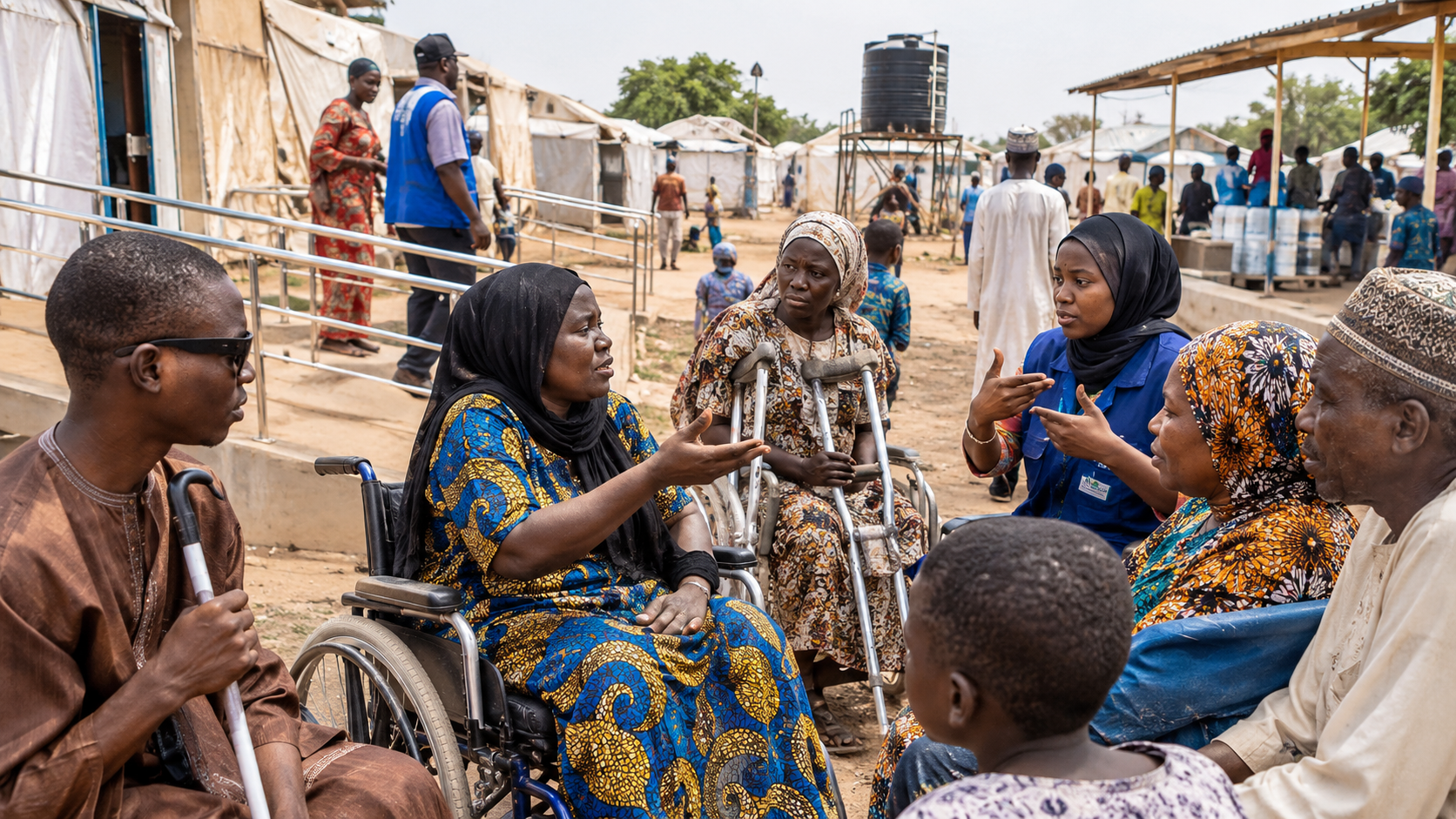
Building on Established Humanitarian Partnerships
JONAPWD’s leadership under this programme is not emerging in isolation. It builds on an evolving body of humanitarian inclusion work supported by strategic partners.
The foundation was strengthened through CBM Global-supported projects implemented in 2023, which advanced JONAPWD’s institutional capacity, OPD coordination and practical engagement in disability-inclusive humanitarian action. Those interventions contributed to strengthening the Association’s ability to mobilise disability constituencies, identify humanitarian barriers and engage duty-bearers on the rights and requirements of persons with disabilities during emergencies.
This experience is now being consolidated through ongoing support from the International Organization for Migration (IOM) and the Global Shelter Cluster, particularly for JONAPWD’s engagement across Nigeria’s northern states. These partnerships are strengthening JONAPWD’s capacity to contribute to inclusive site coordination and site management, accessibility assessments, humanitarian preparedness, protection, community participation and accountable service delivery.
The combined support represents a deliberate institutional progression rather than a series of disconnected projects. The CBM Global interventions helped establish the foundation. Current support from IOM and the Global Shelter Cluster is deepening the practical application of disability inclusion within displacement sites and shelter systems. The present programme provides an opportunity to consolidate that learning and translate it into measurable improvements for displaced persons with disabilities.
Through these partnerships, JONAPWD is strengthening the participation of state and local OPD structures in humanitarian coordination across northern Nigeria. It is also building a pool of disability-inclusion expertise capable of supporting government authorities, humanitarian organisations, site managers and affected communities to identify barriers and implement practical solutions.
This continuity places JONAPWD in a strong position to serve as the national bridge between global humanitarian standards, government responsibilities and the lived experiences of persons with disabilities.
From Beneficiaries to Humanitarian Leaders
JONAPWD’s starting point is clear: persons with disabilities are not merely vulnerable recipients of humanitarian assistance. They are rights-holders, community members, technical contributors, monitors and leaders whose knowledge must shape humanitarian decisions.
Under previous programme interventions, JONAPWD ensures that persons with disabilities participate meaningfully in decisions concerning shelter design, site planning, accessibility, protection, service delivery and recovery. Their participation will extend beyond attendance at meetings. Persons with disabilities and their representative organisations will help identify barriers, establish priorities, assess proposed solutions and monitor whether agreed actions are implemented.
Currently, the programme will intentionally include women and men with physical, visual, hearing, intellectual, developmental, psychosocial and multiple disabilities. It will also recognise the intersecting experiences of children, young people, older persons, women and girls with disabilities, caregivers and people requiring significant support.
This approach will guard against tokenism—the practice of inviting one person with a disability to a meeting and expecting that individual to represent every disability constituency. JONAPWD will promote accountable representation in which disability representatives consult their constituencies, present collective priorities and communicate decisions back to affected residents.
Turning Lived Experience into Technical Evidence
A major component of JONAPWD’s leadership will be the participatory accessibility audit of selected displacement sites, shelters and humanitarian facilities. Persons with different disabilities will participate as co-assessors rather than being treated only as respondents.
The audit will examine the accessibility of shelters, entrances, internal spaces, pathways, water points, toilets, bathing areas, distribution centres, health posts, learning spaces, information points and complaints mechanisms. It will also identify inaccessible communication, discriminatory attitudes, institutional procedures, protection risks and barriers preventing persons with disabilities from participating in site governance.
Accessibility will be assessed as a continuous chain. A shelter cannot be considered accessible simply because it has a ramp. A person must be able to receive information about the shelter, reach the location, enter the building, circulate safely, use its facilities, understand emergency procedures and obtain assistance when required.
The All Under One Roof guidance similarly recommends avoiding new human-made barriers, removing existing obstacles, adapting existing structures and providing accessible transitional or permanent shelter through consultation and participation.
JONAPWD will translate the audit findings into a practical Disability Inclusion Action Plan. Each recommendation will be connected to a responsible institution or service provider, a timeframe, a resource requirement and a measurable indicator. This will ensure that the assessment does not end as a report on a shelf but becomes an instrument for institutional action and accountability.
Mainstreaming Inclusion Across Site Administration, Coordination and Management
The programme recognises that disability inclusion must operate across the three connected functions of site administration, site coordination and site management.
At the level of site administration, JONAPWD will support government and national authorities to incorporate accessibility, disability rights and accountability into their oversight responsibilities. Government leadership is essential for ensuring that inclusion becomes institutional practice and does not depend entirely on temporary humanitarian projects.
At the level of site coordination, JONAPWD will work with humanitarian actors to clarify responsibilities, identify service gaps, reduce duplication and mainstream disability inclusion across shelter, protection, health, education, food assistance, water, sanitation and hygiene, and livelihood interventions. Disability inclusion cannot remain confined to a specialist organisation while mainstream humanitarian services continue to exclude persons with disabilities.
At the level of site management, JONAPWD will support practical improvements in infrastructure, service arrangements, communication, participation, referrals, feedback mechanisms and everyday accessibility within displacement sites.
JONAPWD will not replace government authorities, site managers or humanitarian organisations. Its leadership will strengthen their capacity to fulfil existing responsibilities inclusively. The Association will bring disability expertise, OPD legitimacy and lived-experience accountability into the structures through which humanitarian decisions are made and implemented.
Building the Capacity of Humanitarian Institutions
Sustainable disability inclusion requires more than awareness. Humanitarian actors must possess the knowledge, tools and institutional confidence to recognise barriers and respond appropriately.
JONAPWD will therefore lead capacity strengthening for government authorities, site administrators, site coordinators, site managers, humanitarian workers, community leaders and volunteers. Training and practical mentoring will address the UN Convention on the Rights of Persons with Disabilities, humanitarian principles, accessibility, reasonable accommodation, protection, safeguarding, inclusive communication and meaningful OPD participation.
The capacity-building process will focus on changes in practice. Participants will learn how to organise accessible meetings, provide information in multiple formats, improve identification and registration processes, make distributions more inclusive, establish accessible complaints mechanisms and incorporate disability indicators into monitoring and reporting systems.
This institutional-development role is essential because humanitarian organisations may support disability inclusion in principle while lacking practical knowledge of how to implement it. JONAPWD will help close the distance between commitment, institutional practice and measurable results.
Making Humanitarian Information Accessible
Information can be as important as physical infrastructure during an emergency. A person who cannot access an evacuation warning, distribution announcement, registration instruction or complaints procedure may be excluded even when services are physically available.
JONAPWD will help the programme communicate through appropriate formats, including sign language, audio, large print, Braille, Easy Read, pictorial information and accessible digital channels. Communication methods will be selected according to the requirements identified within each displacement site.
The Association will also support accessible meeting venues, adequate lighting, reduced background noise, advance circulation of information, transportation assistance and other reasonable accommodations required for meaningful participation.
The Global Shelter Cluster guidance recommends providing information in multiple accessible formats, planning inclusive meetings and ensuring that monitoring and feedback mechanisms include persons with disabilities and address identified barriers.
Accessible communication will therefore be treated as an operational requirement rather than an optional communication product.
Ensuring Equal Access to Humanitarian Distribution
Distributions of shelter materials, household items and emergency assistance frequently present serious barriers for persons with disabilities. Distribution centres may be distant or physically inaccessible. Materials may be too heavy to transport. Long queues may create health and protection risks, while information and instructions may not be available in accessible formats.
JONAPWD will advise programme actors on accessible distribution locations, priority arrangements, transportation support, home delivery, shaded waiting areas, accessible toilets and trained volunteers who can provide communication, orientation and mobility assistance.
The Association will also facilitate consultation on the suitability of standard household and shelter kits. Some residents may require adapted or additional items to use their shelters safely and independently. The relevant guidance recommends consulting OPDs on distribution systems and household items, providing accessible instructions and including persons with disabilities in monitoring whether materials were received and used.
These measures should not be interpreted as preferential treatment. They are reasonable arrangements required to provide equitable access to humanitarian assistance.
Strengthening Protection, Gender Equity and Safeguarding
Humanitarian emergencies can expose persons with disabilities to heightened risks of violence, exploitation, neglect and abuse. These risks may be particularly severe for women and girls with disabilities, persons with intellectual or psychosocial disabilities, people separated from caregivers and individuals who lose assistive devices during displacement.
JONAPWD will ensure that shelter and site-management interventions apply an intersectional protection lens. Women and girls with disabilities will be consulted in safe and accessible environments. Protection information, reporting mechanisms and referral pathways will be assessed for accessibility, confidentiality and responsiveness.
The programme will examine whether shelter arrangements provide adequate privacy, whether toilets and bathing facilities can be reached safely and whether complaints mechanisms protect users from retaliation. Protection concerns identified through programme activities will be referred through established confidential and survivor-centred systems.
Inclusive Early Warning and Evacuation
Preparedness systems frequently fail because they are designed for an imagined “average” person. Warning messages may depend entirely on sound, written information or mobile technology. Evacuation plans may assume that everyone can move independently and quickly.
JONAPWD will support the development and testing of inclusive early-warning and evacuation arrangements. Persons with disabilities will identify preferred communication methods, map risks, recommend reasonable accommodations and participate in simulation exercises as planners, responders and monitors—not merely as people waiting to be rescued.
Evacuation planning will consider mobility support, caregivers, medication, assistive devices, accessible transportation, safe assembly points and continuity of essential services. The All Under One Roof guidance recommends involving persons with disabilities in the planning, management and monitoring of early-warning systems and establishing evacuation communication chains jointly with communities and OPDs.
Converting Consultation into Accountability
JONAPWD will lead the monitoring of disability-inclusion commitments made under the programme. Persons with disabilities will participate in determining whether agreed barriers have been removed, reasonable accommodation has been provided, services have become accessible and complaints receive timely responses.
Accessible feedback mechanisms will allow residents to raise concerns confidentially through different communication channels. JONAPWD will work with responsible actors to track unresolved issues and ensure that findings are considered within existing site-administration, coordination and management structures.
This approach will move the programme from consultation without consequence to participation backed by accountability. Persons with disabilities will not simply identify problems; they will be involved in agreeing solutions, monitoring implementation and reviewing the actions taken in response.
Building a Model for Wider Humanitarian Reform
The significance of the programme extends beyond one displacement site or one cycle of activities. JONAPWD will document its methods, challenges, solutions and results to generate evidence for wider humanitarian reform in Nigeria.
The lessons can support government institutions, humanitarian organisations, clusters and OPDs to adopt disability-inclusive approaches across other camps, informal displacement locations, host communities and emergency-response programmes. The intervention will demonstrate how international standards can be translated into practical improvements within local humanitarian systems.
This reflects the fundamental purpose of All Under One Roof: transforming how humanitarian organisations approach inclusion and accessibility in shelter and settlement programmes.
The programme should therefore be understood as part of a wider institutional pathway through which JONAPWD, supported over time by CBM Global, IOM and the Global Shelter Cluster, is building sustainable disability-inclusive humanitarian systems across northern Nigeria and generating lessons capable of informing national practice.
Through JONAPWD’s leadership, disability inclusion will not be reduced to a ramp, a specialised activity or an occasional consultation. It will become a standard running through preparedness, assessment, design, budgeting, infrastructure, communication, protection, distribution, governance, monitoring, recovery and reconstruction.
The programme ultimately advances a simple but transformative principle: humanitarian shelter is not truly safe, dignified or adequate unless persons with disabilities can reach it, enter it, use it, influence it and hold those responsible for it accountable.
JONAPWD will provide the movement leadership, national coordination, lived-experience authority and technical expertise required to make that principle a reality—ensuring that no person with a disability is left outside the shelter, the service system or the decisions that shape humanitarian response.